Educational & Career Skills

Percentage Calculator Skills You Need: Essential Quantitative & Workplace Math

Quick Answer & Key Takeaway (TL;DR)

Essential quantitative numeracy requires mastering four core percentage skills: computing parts of wholes, applying sales taxes and markups, calculating percentage growth, and differentiating between percentage points and relative percent changes. Developing strong mental benchmarks accelerates decision-making in meetings and daily commerce.

From reviewing marketing conversion rates to analyzing medical dosages and reviewing quarterly financial results, strong quantitative competence is one of the highest-leverage career assets. Here are the percentage calculator skills you need in modern workplaces.

The 4 Core Percentage Skills Every Professional Needs
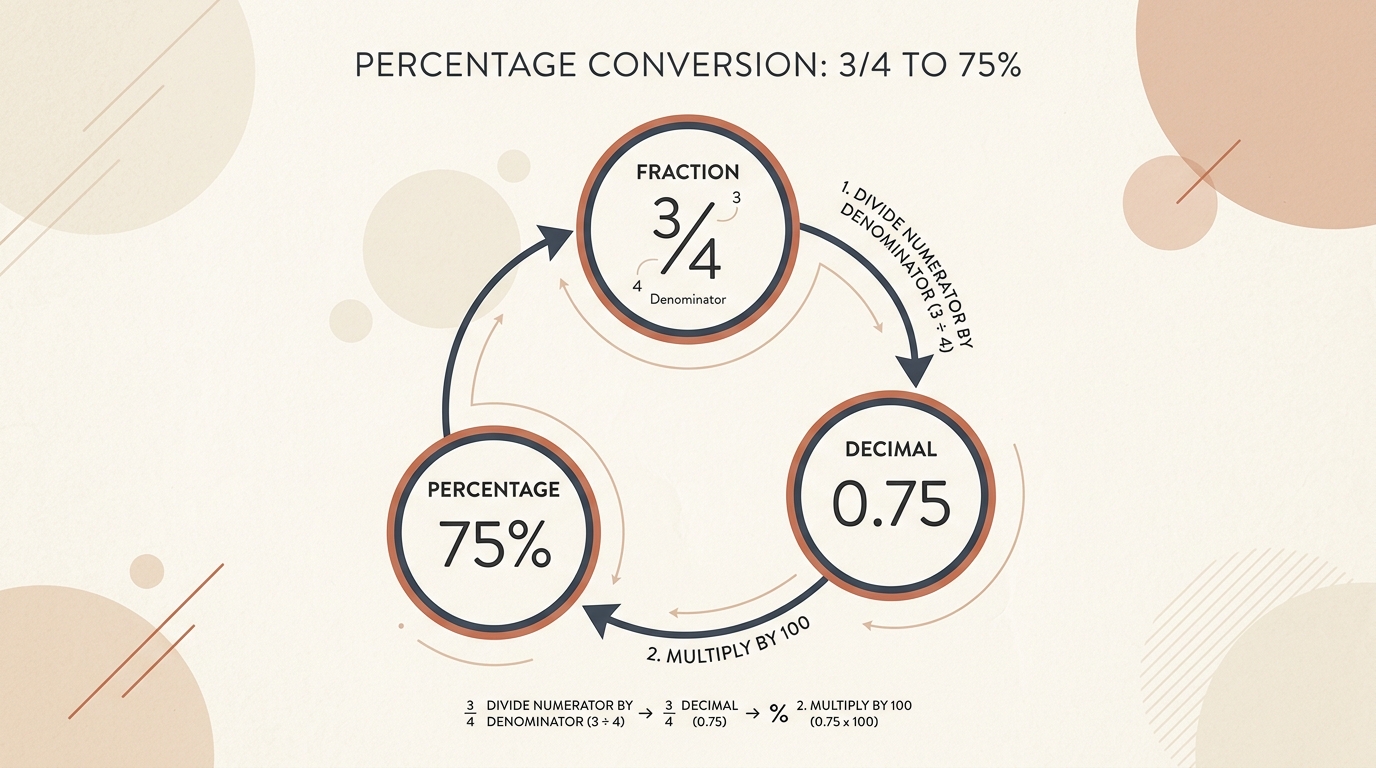
Essential Quantitative Math Skills
Core numeracy skills required for workplace analysis, budgeting, and commerce.
  1. Proportional Assessment: Knowing how to express sub-segments of a project or budget as a percent of total resources.
  2. Commercial Markups & Margins: Distinguishing between markup on cost versus profit margin on revenue.
  3. Comparative Growth Tracking: Accurately calculating Year-over-Year (YoY) and Month-over-Month (MoM) variance.
  4. Reversal Calculations: Finding pre-tax and pre-discount baselines from finalized receipt figures.
Practice these workplace calculations anytime using our verified online percentage calculator.

Percentage Points vs. Relative Percent Change

Confusing percentage points with percentages causes serious communication errors in executive presentations. For instance, if inflation moves from 2% to 4%, inflation increased by 2 percentage points, but the relative rate of inflation surged by 100%!

Mental Arithmetic Benchmarks

Use the 10% rule in meetings: To calculate 15% of $160 quickly, find 10% ($16), take half for 5% ($8), and add them together: $16 + $8 = $24.

When high precision is needed, verify your numbers on our Ratio and Change Tools.

Frequently Asked Questions

What is the difference between percentage and percentage points?
Percentage points describe the arithmetic difference between two percentages (e.g., an interest rate rising from 4% to 5% is a 1 percentage point increase). Relative percent change measures proportional growth (a rise from 4% to 5% is a 25% relative increase).
Why should professionals use verified online calculators?
Automated calculators eliminate mental arithmetic errors and prevent costly oversights in invoicing, tax compliance, and financial reporting.

Dr. Evelyn Reed

Quantitative Analyst & Mathematics Educator

Dr. Evelyn Reed holds a Ph.D. in Applied Mathematics and specializes in statistical analysis, financial numeracy, and computational precision systems.

Put These Formulas into Practice

Test any formula with custom numbers using our verified, in-browser mathematical calculators: